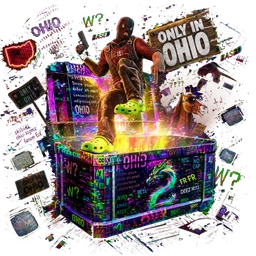
Digital economies within video games have evolved dramatically over the last decade. Among the most popular and enduring features of modern gaming culture is the concept of case opening. Whether referring to weapon finishes in Counter-Strike 2, cosmetic loot boxes in various multiplayer titles, or physical trading card game booster packs, the ritual of unlocking a sealed container for a chance at a rare item remains a massive industry.
This comprehensive guide explores the mechanics behind case openings, the mathematics governing the odds, the psychological factors at play, and how enthusiasts approach the hobby responsibly.
What is Case Opening?
At its core, case opening is a transaction where a user exchanges real or virtual currency for a virtual key (or equivalent mechanism) to unlock a randomized container. Once opened, the container generates a single item chosen from a predetermined pool of possible rewards.
While popularised heavily by Valve’s Counter-Strike franchise, the concept spans across numerous genres:
- First-Person Shooters: Unlocking weapon skins, gloves, and knives.
- MMORPGs: Opening lockboxes for mounts, pets, and gear.
- Collectible Card Games (CCGs): Opening booster packs for digital or physical cards.
The Anatomy of a Case Opening System
| Component | Function | Description |
|---|---|---|
| The Container | The Goal | A locked box, crate, or capsule dropped in-game or purchased on a marketplace. |
| The Key | The Access Token | A purchased item required to unlock the container. Prices are typically standardized by the game developer. |
| The Item Pool | The Reward Set | The complete list of possible items obtainable from that specific container, categorized by rarity. |
| The RNG Engine | The Decider | A cryptographically secure Random Number Generator that determines the outcome the moment the key is applied. |
The Mathematics and Odds of Case Openings
One of the most frequently misunderstood aspects of case opening is probability. Because virtual items hold real-world monetary value on peer-to-peer marketplaces, understanding the math is crucial for anyone participating in the ecosystem.
Publishers are often legally required (or voluntarily choose) to disclose drop rates to maintain transparency. Typically, items are divided into distinct tiers based on scarcity.
Typical Probability Tiers in Virtual Cases
| Tier Name | Visual Indicator | Estimated Drop Rate | Market Value Implication |
|---|---|---|---|
| Consumer / Common | Light Blue / Gray | ~79.92% | Very low; usually worth pennies. |
| Industrial / Uncommon | Dark Blue | ~15.98% | Low; minimal resale value. |
| Mil-Spec / Rare | Purple | ~3.20% | Moderate; standard baseline for decent pulls. |
| Restricted / Mythical | Pink | ~0.64% | High; notable value above key cost. |
| Classified / Legendary | Red | ~0.13% | Very High; significant market demand. |
| Covert / Exceedingly Rare | Yellow / Gold | ~0.26% (Combined) | Premium; hundreds to thousands of dollars. |
Note: Percentages are generalized models based on publicly disclosed figures from major tactical shooter titles.
The mathematical reality of these odds dictates that the “house” (the game developer or platform) nearly always maintains a negative expected value (£EV£). In simpler terms, the average value of the items retrieved from opening 100 cases is almost always significantly lower than the total cost of purchasing 100 keys and cases.
The Psychology Behind the Spin
Why do millions of players continue to engage in case openings despite the mathematical odds? Behavioral psychologists point to several key mechanics that make the experience compelling:
- The Near-Miss Effect: Watching a virtual wheel slow down and stop just one slot away from a rare knife triggers the same dopamine response in the brain as a win. This encourages the user to try “just one more time.”
- Variable Ratio Reinforcement: This is the same psychological principle that makes slot machines addictive. Because rewards are unpredictable, the brain remains hooked in anticipation of the next big payout.
- The Spectator Culture: Streaming platforms like Twitch and YouTube have turned case openings into spectator sports. Content creators opening thousands of dollars worth of virtual goods generate massive viewership, normalizing the practice for younger audiences.
- Tangible Value: Unlike traditional video game purchases that remain locked to an account, many ecosystems allow players to trade, sell, or cash out their virtual items, blurring the line between gaming and digital asset trading.
Best Practices for Approaching Case Openings
For those who choose to participate in case openings, establishing strict boundaries ensures the hobby remains an entertaining pastime rather than a financial burden.
- Set a Strict Budget: Decide beforehand how much money can be spent within a given month, and treat that money as spent (i.e., money paid for entertainment, much like a movie ticket), not as an investment.
- Understand the Alternatives: If a specific skin or item is desired, buying it outright from a community marketplace is almost always cheaper than trying to unbox it through randomized cases.
- Avoid Chasing Losses: A common pitfall is spending more money to “make back” what was lost on previous failed openings. The RNG has no memory; past losses do not influence future odds.
- Verify Platform Legitimay: If using third-party case opening websites (outside of official game clients), research the platform thoroughly to ensure fair-play algorithms, secure logins, and reliable withdrawal systems.
Frequently Asked Questions (FAQ)
1. Are case openings considered gambling?
The legal definition varies by jurisdiction. Because virtual items often hold real-world monetary value and outcomes are randomized, many government regulatory bodies classify certain types of loot boxes and case openings as a form of gambling. Several countries have banned or heavily restricted them as a result.
2. Can you influence the outcome of a case opening?
No. The outcome of a case opening is determined instantly by a server-side Random Number Generator (RNG) the exact moment the animation begins. Visual elements like spinning wheels or scrolling items are purely cosmetic and do not affect the final result.
3. Is it better to open cases or buy items directly?
From a financial standpoint, buying items directly from a marketplace is vastly superior. Case openings rely on low-probability drops, meaning the vast majority of players will spend more money trying to unbox a specific item than that item’s actual market price.
4. What happens to items won from a case?
Depending on the game, items are added directly to the player’s inventory. From there, they can typically be equipped in-game, traded with other players, or sold on official or third-party marketplaces for game credits or real currency.
Browse CS2 skin designs and learn how a CS2 Case shapes your inventory, from coveted rare drops to colorful weapon finishes.
